🏠TARI in Italy: Who Pays the Waste Tax—Tenant or Landlord?
If you are renting a home in Italy, you may receive a bill called TARI and wonder:
“Should I pay this, or should my landlord?”
The answer is usually quite simple: TARI generally follows the person who occupies or uses the property.
However, there is an important exception for short-term occupancy.
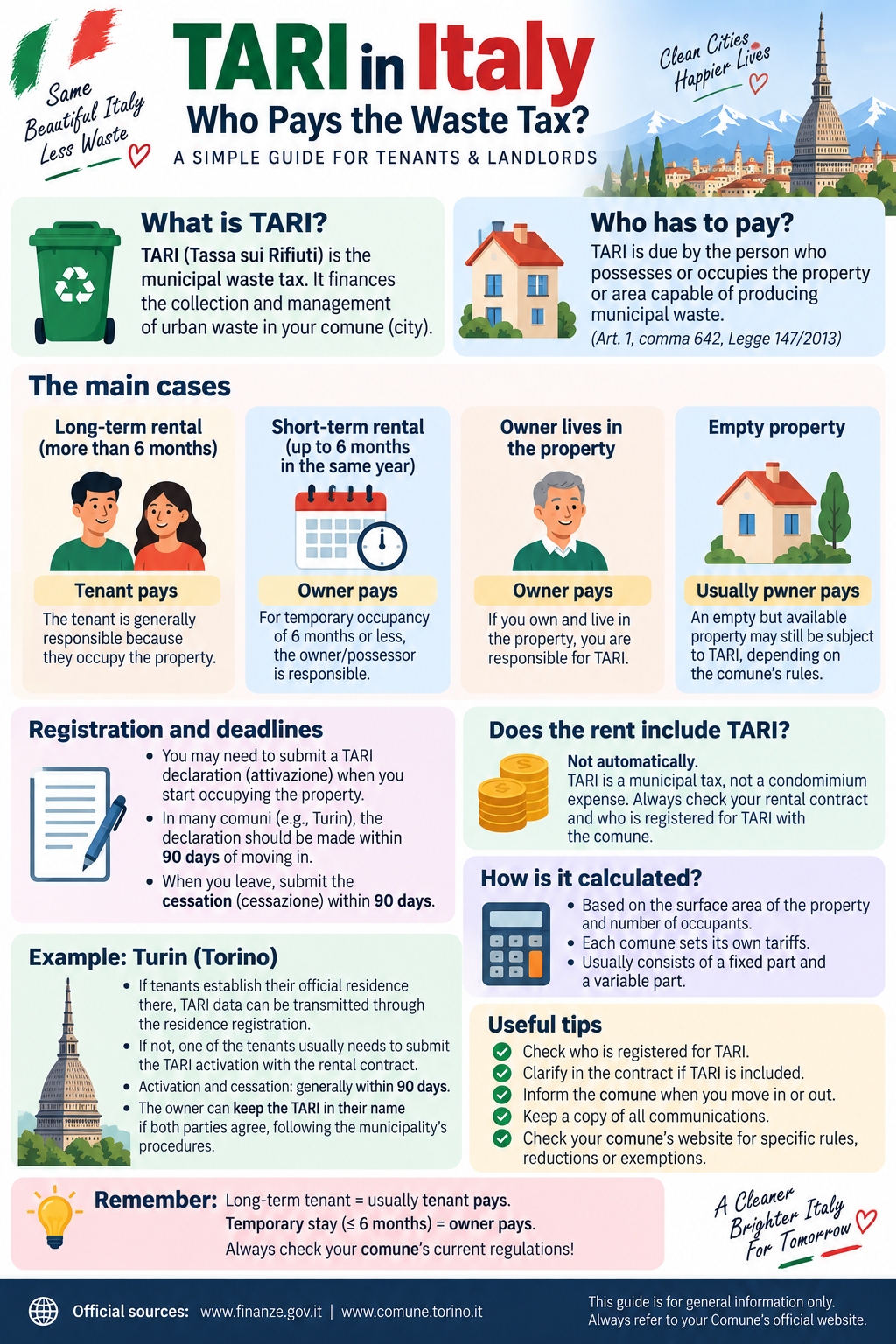
TARI in Italy: Who Pays the Waste Tax—Tenant or Landlord?
Keywords: tassa rifiuti, TARI affitto, TARI inquilino, TARI proprietario, chi paga la TARI, TARI inquilino o proprietario, TARI casa in affitto
What is TARI?
TARI (Tassa sui Rifiuti) is Italy's municipal waste tax. It helps finance the collection and management of urban waste.
Under the general rules, TARI applies to anyone who possesses or occupies premises or areas capable of producing municipal waste.
This means that being the legal owner of the property does not automatically mean being the person responsible for TARI.
👉 Official reference: Italian Ministry of Economy and Finance – Fiscalità Locale
🏠 So, who pays: tenant or landlord?
For a normal long-term residential rental, the tenant is generally responsible for TARI because the tenant is the person occupying the property.
For example:
You rent an apartment for 4 years → normally, you pay the TARI.
This applies to common long-term rental arrangements such as a 4+4, 3+2, or another rental where the tenant has ongoing possession of the property.
The national TARI framework makes the person who possesses or holds the property liable for the tax.
⏳ The important 6-month rule
There is an important exception.
When the property is occupied temporarily for no more than six months during the same calendar year, TARI is payable by the possessor of the property, such as the owner, rather than the temporary occupant.
This rule comes from Article 1, paragraph 643 of Law 147/2013.
So, as a simple guide:
Situation
Normally responsible for TARI
Tenant rents for more than 6 months
👤 Tenant
Temporary occupancy ≤ 6 months in the same calendar year
🏠 Owner/possessor
Owner lives in their own property
🏠 Owner
Owner keeps an available/usable property
🏠 Owner, subject to local rules
Property changes tenant
🔄 TARI position should be updated
Easy rule to remember
Long-term tenant = usually tenant pays.
Temporary occupancy of no more than 6 months in the same calendar year = owner/possessor pays.
📄 “But my rent includes condominium expenses!”
This is where many tenants get confused.
Your monthly payment might include:
Rent + condominium charges + heating/water + other building expenses.
That does not automatically mean TARI is included.
TARI is a municipal tax, not simply a condominium expense.
Therefore, before assuming that your landlord has already paid it, check your rental agreement and, more importantly, check whose name the TARI position is registered under with the Comune.
⚠️ Don't assume the rental contract automatically activates TARI
Another common mistake is thinking:
“I registered my rental contract, so the Comune already knows I live there.”
Do not rely on this assumption.
The administrative procedure depends on the municipality. You may need to submit a TARI declaration/activation (denuncia or dichiarazione TARI) when you start occupying the property.
You should also update or close the position when you leave.
Always check the TARI section of the website of the Comune where the property is located.
📍 Example: How it works in Turin
The City of Turin provides a useful real-world example.
For residential properties rented for more than six months, Turin explains that when tenants transfer their official residence to the property, TARI information can be transmitted through the residence-change procedure.
If the tenants do not establish official residence there, one of the tenants generally needs to submit the TARI activation declaration and provide the rental contract.
Interestingly, Turin also allows the owner to keep or register the TARI in their own name if the parties agree, subject to the municipality's procedures.
This is a good example of why you should distinguish between:
Who is legally responsible under the general TARI rules
and
How the individual Comune manages the TARI account.
⏰ What happens when you move into a property?
Check your municipality's deadline immediately.
For example, in Turin, the initial declaration should generally be submitted within 90 days from the beginning of possession, detention or occupation of the property.
So when moving into a new rental, remember:
Rental contract ✔️
Residence registration, if applicable ✔️
Electricity/gas ✔️
Internet ✔️
TARI ✔️
Don't let TARI be the forgotten one.
🚚 What happens when the tenant moves out?
This is equally important.
If the TARI account is registered to the tenant, the tenant should verify that the position is closed when leaving the property.
Otherwise, the municipality may continue to associate that person with the property.
For example, Turin states that if the tenant was the TARI holder and leaves, the tenant should submit the cessation declaration, while the owner should activate their position unless a new tenant takes over.
In Turin, the cessation declaration should generally be made within 90 days from the end of possession, detention or occupation.
🏚️ What if the apartment is empty?
An empty apartment does not necessarily mean:
“No one lives there = no TARI.”
Municipal regulations matter.
For example, Turin distinguishes between a property that is genuinely empty and without active utilities and a property that remains available for occasional use. The latter can remain subject to TARI.
So landlords should not automatically stop paying TARI simply because a tenant has moved out.
Check the property's actual status and the rules of the relevant Comune.
💰 How is TARI calculated?
The exact calculation varies by municipality.
For domestic properties, the amount commonly takes into account factors such as:
the taxable surface area of the property and the number of occupants.
The tariff generally contains a fixed component and a variable component. For example, Turin describes its TARI tariff as consisting of a fixed part related to service costs and a variable part related to waste/service parameters.
This is why two apartments of similar size can sometimes receive different TARI bills.
🚨 A common mistake for tenants
Imagine this situation:
You rent an apartment for several years.
The landlord tells you:
“Everything is included in the rent.”
You assume this includes TARI.
Years later, you discover that the TARI position was never correctly activated or updated.
This can create unnecessary problems involving unpaid tax, corrections, interest or penalties.
The safest approach is simple:
Check who is registered for TARI rather than assuming who is paying it.
✅ Before renting a home in Italy, check these 5 things
Is TARI included in what I pay the landlord?
Whose name is the TARI account registered under?
Do I need to register/activate TARI with the Comune?
How many occupants are registered for the property?
What do I need to do when I move out?
These five questions can prevent a lot of confusion later.
🎯 The Bottom Line
For most ordinary long-term rentals in Italy:
👤 Tenant occupying the home long-term?
The tenant is generally responsible for TARI.
🧳 Temporary occupancy for no more than 6 months in the same calendar year?
The owner/possessor is generally responsible.
🏠 Property not rented?
The owner may be responsible, depending on the property's status and the municipality's rules.
Most importantly, TARI is administered locally, so procedures, deadlines, tariffs, reductions and exemptions can vary from one Comune to another.
Always check the official website of your municipality before relying solely on what is written in your rental contract.
🔗 Useful official sources
🇮🇹 Italian Ministry of Economy and Finance – Fiscalità Locale
🏛️ City of Turin – TARI information
📝 City of Turin – TARI activation for residential properties
Disclaimer: This article provides general information and is not tax or legal advice. TARI is administered by individual municipalities, so always verify the current regulations of the Comune where the property is located.